
Application Maintenance & Support
Web Application Maintenance & Support Services
Keep important software working after the original build is over.
We maintain, support, troubleshoot, and improve custom web applications that businesses depend on for daily operations.
Whether we built the application or inherited it from another developer or agency, we can help stabilize the system, resolve problems, keep dependencies and infrastructure current, and continue developing the software as your requirements change.
Software Doesn't Stop Changing After Launch
Your Application Is Still Running. Someone Still Needs to Own It.
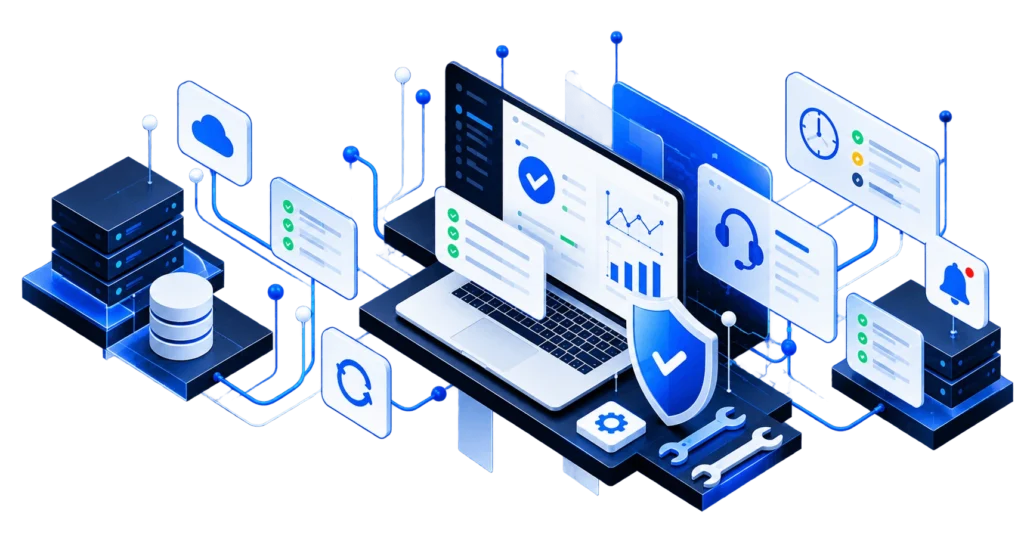
A custom application can remain useful for years after its initial development, but production software is never completely finished.
Frameworks and dependencies change. External APIs are updated. Security issues are discovered. Business rules evolve. Employees find edge cases. Customers request new functionality. Infrastructure needs attention. The original developer may eventually move on.
Without clear technical ownership, small issues accumulate until routine changes become difficult or an unexpected failure becomes urgent.
Ongoing application support may make sense when:
-
Your application is important to the business but no longer has a dedicated developer.
-
The original developer or agency is no longer available.
-
Updates have been postponed because nobody is comfortable changing the existing code.
-
Frameworks, packages, runtimes, or infrastructure are falling behind.
-
Recurring bugs or production issues are consuming staff time.
-
Third-party integrations periodically break or require updates.
-
The application needs regular improvements but not a full internal development team.
-
The software has effectively become something nobody wants to touch.
Existing Application Takeover
We Can Take Over Software Someone Else Built
You do not need access to the original developer forever in order to keep a custom application alive.
We can take over existing web applications when a freelancer disappears, an agency relationship ends, an internal developer leaves, the original team no longer supports the system, or the business simply needs different technical ownership.
The first step is not immediately changing the code.
We start by understanding the application, its infrastructure, data, integrations, dependencies, deployment process, known problems, and the business workflows people depend on.
Before changing an inherited application, we need to understand what the business is depending on.
Takeover Assessment
Understand the Application Before Taking Responsibility for It
An inherited application often comes with incomplete documentation and years of decisions that are not obvious from the interface.
Before establishing an ongoing maintenance plan, we review the areas that affect our ability to work on the system safely.
Application and Data
Review the source code, architecture, important business logic, database structure, critical records, and areas likely to be difficult or risky to change.
Dependencies and Infrastructure
Identify frameworks, runtimes, libraries, hosting environments, scheduled processes, queues, backups, storage, and other technical dependencies.
Integrations and Access
Understand third-party APIs, payment systems, external platforms, authentication, user roles, permissions, and credentials involved in important workflows.
Deployment and Operations
Determine how changes reach production, what monitoring or logging exists, how recovery works, and whether deployment can be made safer or more repeatable.
Known Problems and Technical Debt
Separate immediate operational risks from improvements that can be addressed gradually rather than treating every imperfection as an emergency.
Stabilize Before You Expand
Fix the Things That Make Routine Development Risky
An inherited application may not be ready for immediate feature development.
If deployments are undocumented, backups are uncertain, dependencies are severely outdated, production errors are invisible, integrations are failing, or nobody understands how critical workflows behave, adding new functionality can increase risk.
In those situations, the first phase may focus on stabilization.
That can include resolving critical bugs, documenting environments and deployment procedures, verifying backups, addressing severely outdated dependencies, improving logging and monitoring, repairing integrations, fixing obvious security problems, and adding tests around high-risk application behavior.
Once the system is understood and stable enough to change safely, ongoing maintenance and development become more predictable.
Ongoing Application Maintenance
Keep the Application Current, Reliable, and Maintainable
Application maintenance is the engineering work required to keep production software healthy as the technology and business around it continue changing.
Bug Fixes and Troubleshooting
Investigate application errors, unexpected behavior, failed workflows, database problems, permission issues, background processes, and other production problems to identify and correct the underlying failure.
Framework and Dependency Maintenance
Keep application frameworks, runtimes, libraries, and packages current when upgrades are appropriate and address compatibility, deprecation, and dependency-related security issues.
Integration Maintenance
Update and repair third-party connections as providers change authentication, endpoints, payloads, rate limits, or other API requirements.
Security and Access
Address identified application-level security issues, authentication problems, dependency vulnerabilities, configuration concerns, and access-control requirements.
Performance and Database Work
Investigate slow requests, database queries, background processing, caching, schema changes, migrations, indexes, and other issues affecting application performance or data.
Compatibility and Production Operations
Resolve frontend or environment issues as browsers, devices, infrastructure, configuration, and deployment requirements change.
Beyond Maintenance
Keep Improving the Application Instead of Only Keeping It Alive
Maintenance does not mean freezing useful software in its current state.
Once the application is understood and stable enough to change safely, ongoing engineering can include new features, workflow improvements, reporting, integrations, interface changes, automation, administrative tools, performance work, and other enhancements.
Some organizations need occasional development. Others maintain a backlog and need predictable engineering capacity.
That work can be handled through separately scoped projects, development phases, or an ongoing arrangement depending on the volume and predictability of the work.
Maintenance or Modernization?
When Maintenance Is No Longer Enough
Not every aging application should be maintained indefinitely in its current form.
Routine maintenance makes sense when the application’s architecture remains workable and the cost of keeping it healthy is reasonable.
Modernization becomes worth considering when ordinary changes require disproportionate effort, important dependencies can no longer be upgraded safely, the architecture blocks needed functionality, technical limitations create ongoing security or infrastructure problems, or large portions of the application are becoming more expensive to preserve than improve.
That still does not automatically mean rebuilding the entire application. Modernization can focus on the areas creating the most risk, cost, or development friction.
Application Operations
Define Who Is Responsible for What
An application needs infrastructure to run, but infrastructure management and application development are not the same service.
For supported applications, managed hosting and infrastructure responsibilities can include deployments, backups, SSL and environment configuration, monitoring, routine platform maintenance, and agreed infrastructure support.
Application maintenance covers the software itself: bugs, dependencies, integrations, security work, business logic, enhancements, and other application changes.
We define those responsibilities during scoping so there is a clear understanding of what is being maintained and who owns each part of the production environment.
Ongoing Engineering
Support Should Match How Much Help the Application Actually Needs
Different applications require different levels of ongoing involvement.
Maintenance and Support
Appropriate when the primary need is keeping an existing application healthy through bug fixes, updates, integration maintenance, and defined support responsibilities.
Continued Development
Appropriate when the business expects a recurring stream of enhancements, integrations, reporting changes, workflow improvements, and other development work.
Scoped Development Phases
Appropriate when larger improvements can be defined and delivered as separate projects rather than treated as routine maintenance.
The right arrangement depends on the application’s condition, importance, rate of change, expected workload, and the response expectations the business actually needs.
Response Expectations
Define Support Expectations Before There Is an Emergency
“Support” can mean very different things to different organizations.
A support agreement should define which systems are covered, what work is included, how requests are submitted, how priorities are handled, and what response expectations apply.
Applications requiring formal around-the-clock operations, guaranteed rapid incident response, or a dedicated operations team may require a different support model.
We establish those expectations before the engagement begins rather than discovering during a production problem that each side had a different definition of support.
Taking Ownership of an Existing Application
How an Application Support Relationship Begins
Understand the Business and Gain Access
Identify who depends on the application, which workflows matter most, what problems currently exist, and collect the source code, infrastructure, database, vendor accounts, documentation, and other access needed to investigate the system.
Assess the Application
Review the architecture, dependencies, infrastructure, integrations, deployment process, data, known bugs, security concerns, and overall maintainability.
Stabilize and Prioritize
Separate immediate operational risks from longer-term technical debt, resolve critical problems where necessary, and establish enough production visibility to work on the application responsibly.
Establish the Ongoing Plan
Define maintenance priorities, support responsibilities, infrastructure ownership, development needs, and the appropriate working arrangement, then continue maintaining and improving the application as requirements change. FAQ
Application Maintenance & Support FAQs
Can you maintain an application you did not build?
Yes. We can take over existing custom web applications after reviewing the codebase, infrastructure, dependencies, integrations, deployment process, and current technical condition.
Some applications require an initial assessment or stabilization phase before routine maintenance or feature development begins.
What does web application maintenance include?
Maintenance can include bug fixes, framework and dependency updates, security work, integration maintenance, database changes, performance improvements, compatibility fixes, troubleshooting, and other engineering required to keep the application healthy.
What if there is little or no documentation?
A lack of documentation does not necessarily prevent a takeover, but it increases the amount of technical discovery required.
We can inspect the codebase, infrastructure, database, configuration, integrations, and production behavior to reconstruct enough understanding to maintain the system responsibly.
Can you add new features while maintaining the application?
Yes. Once the application is understood and stable enough to change safely, maintenance can be combined with ongoing feature development or separately scoped improvement phases.
Do you provide hosting and emergency support?
Managed hosting and infrastructure support can be provided for appropriate applications, with responsibilities defined separately from application development and maintenance.
Support coverage and response expectations are established for each engagement. Applications requiring formal 24/7 operations, guaranteed rapid incident response, or a dedicated operations team may require a different support model.
How much does application maintenance cost?
Cost depends on the application’s size, technical condition, infrastructure, integrations, support expectations, and expected development workload.
An inherited or higher-risk application may first require a paid technical assessment or stabilization project before ongoing support can be estimated responsibly.
Need Someone to Own the Application?
You Don't Have to Rebuild It Just Because the Original Developer Is Gone
Tell us what the application does, who depends on it, what technology you know it uses, and what problems you’re currently dealing with.
We can review the existing system, identify what needs attention, and determine whether the right next step is maintenance, stabilization, continued development, or modernization.