
SaaS Product Development
Custom SaaS Development
Turn a validated software opportunity into a product people can actually use, operate, and improve.
We design and develop custom SaaS applications for established businesses, funded teams, and software companies building new products or extending existing ones.
From the first production release through subscriptions, administration, integrations, reporting, and continued product development, we build the systems required to operate the software behind the interface.
Built for Serious Product Development
SaaS Development for Teams Ready to Invest in the Product
Custom software development requires meaningful investment. The strongest SaaS engagements usually begin with a validated business opportunity, existing customers or workflows, committed funding, or an established product that needs additional engineering.
We are a good fit for:
-
Established businesses turning an existing service, workflow, or operational capability into a software product.
-
Funded teams building a new SaaS application.
-
Companies with a validated product concept that need engineering to reach production.
-
Existing SaaS businesses developing major new functionality.
-
Product teams replacing prototypes or early implementations that cannot support the next stage of the product.
-
Organizations developing specialized B2B software around industry-specific workflows or data.
From Product Requirements to Production Software
A SaaS Product Is More Than the Feature Users See
The central product idea may be straightforward. Building the software around it usually is not.
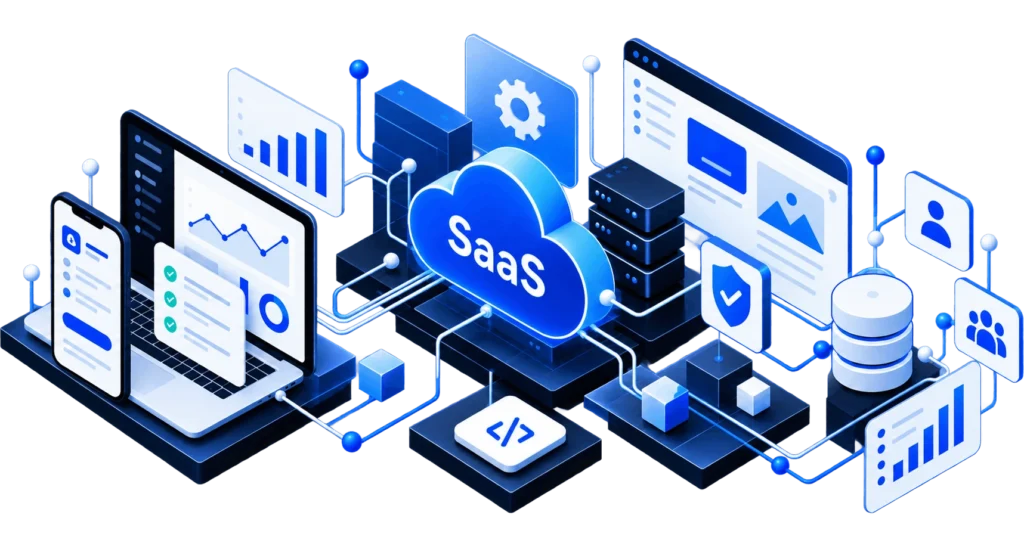
A production SaaS application may need authentication, permissions, account management, subscriptions, billing, notifications, administration, reporting, integrations, background processing, data management, and support tools alongside the functionality customers are actually paying for.
Those systems need to work together without making every future product change unnecessarily difficult.
We help turn product requirements into a maintainable web application that can be launched, operated, measured, and extended as the product develops.
If the product is still only an idea, validating the problem, intended users, and commercial assumptions may be more useful than immediately committing significant money to custom development.
SaaS Application Development
Software Products Built Around the Business Behind Them
Every SaaS product has different requirements, but most combine product-specific functionality with systems for managing users, accounts, data, operations, and the commercial model behind the software.
B2B SaaS Applications
Software built around specialized business workflows, operations, collaboration, data, reporting, or industry-specific requirements.
Multi-User and Multi-Account Products
Applications supporting users, organizations, teams, roles, permissions, and different account structures within the same product.
Subscription Products
Connect plans, subscriptions, billing, account status, and product access when recurring revenue is part of the business model.
Workflow and Data Products
Build products around approvals, scheduling, records, documents, tasks, calculations, reporting, analytics, or other structured processes.
Integration-Driven Products
Develop applications whose value depends on exchanging data or coordinating workflows with external platforms, APIs, databases, and services.
Administration and Product Operations
Give internal teams practical tools for managing users, accounts, subscriptions, permissions, configuration, support actions, and other product operations.
SaaS MVP Development
Build the Smallest Product That Can Test the Important Assumptions
An MVP should reduce uncertainty, not simply reduce the number of features.
The useful question is not “How cheaply can we build version one?” It is “What does this product need in order to test whether the core value actually works for the intended users?”
That usually means identifying the smallest complete workflow that delivers the product’s value while avoiding functionality that can wait until there is evidence it is needed.
An initial release might need the core customer workflow, account management, basic administration, and one critical integration. It may not need every reporting view, automation, configuration option, or edge case envisioned for the mature product.
A smaller first release is useful when it answers important product questions. It is not useful when essential functionality is removed simply to make the project cheaper.
Control the First Release
Separate What the Product Needs Now From What It May Need Later
Software products accumulate requirements quickly.
Customers need one workflow. Administrators need another. Sales reveals an integration requirement. Billing introduces additional account states. Reporting expands. Edge cases appear around major features.
Trying to solve every future requirement before the first meaningful release can turn a focused product into a long development cycle without corresponding evidence that the additional investment matters.
We separate core product value and operational requirements from capabilities that can follow in later phases.
The first release should prioritize:
- Functionality required to deliver the product’s core value.
- Requirements necessary to operate the product responsibly.
- Features required by initial customers or validated use cases.
- Technical foundations needed for the expected near-term product direction.
Additional integrations, reporting, automation, account types, administration, and other capabilities can then be delivered in later phases as the product and its priorities become clearer.
That creates natural points to review assumptions and decide where additional investment provides the most value.
Existing SaaS Products
Already Have a Product? We Can Help Build What Comes Next.
SaaS development does not always start with a blank repository.
An existing product may need new workflows, integrations, billing changes, administrative capabilities, reporting, performance improvements, architecture work, or additional development capacity.
We can work within an existing application after understanding its architecture, codebase, infrastructure, development process, and product requirements.
If the current application has accumulated substantial technical debt or become difficult to extend safely, the first step may be stabilization or targeted modernization before major feature work.
Connected Products
Your SaaS Product Probably Will Not Operate Alone
Modern software products often depend on external services for payments, communication, identity, analytics, customer management, data, automation, or specialized functionality.
We build the integration workflows that allow the application to communicate with the systems required by the product.
Production integration work also needs to account for authentication, failures, retries, duplicate events, changing data, rate limits, logging, and what the application should do when an external dependency becomes unavailable.
From Requirements to Release
How We Approach SaaS Product Development
Understand the Product
Define the users, problem, core workflows, business model, existing validation, operational requirements, and what the initial or next release needs to accomplish.
Define the Release
Separate essential functionality from later product ideas and identify important dependencies, integrations, risks, account structures, data requirements, and unresolved decisions.
Design and Build the Application
Turn those requirements into application architecture, interfaces, business logic, data structures, integrations, administration, and other product functionality, then build the release in testable increments.
Validate, Launch, and Continue
Test the workflows, permissions, integrations, data behavior, and operational systems customers will depend on, then deploy the product and use real usage, customer feedback, and business priorities to determine what should come next.
Built Beyond Version One
The First Release Should Leave Room for the Second
A successful SaaS product changes.
Customers reveal requirements that were not obvious during planning. Integrations change. New account types appear. Business rules become more sophisticated. Some early assumptions turn out to be wrong.
The application should be understandable and maintainable enough for the product to respond to those changes.
That means making architecture and engineering decisions proportional to the product’s actual requirements, using technologies the application can realistically support, and avoiding unnecessary complexity that makes ordinary product development harder later.
You cannot predict every future feature. You can leave the product in a position where useful change remains practical.
SaaS Product Development FAQs
What is SaaS development?
SaaS development is the design and engineering of software delivered as an online service.
A SaaS application can include customer accounts, product-specific workflows, permissions, subscriptions, administration, integrations, reporting, and the systems required to operate the service.
Do you build SaaS MVPs?
Yes, when the product is ready for the investment required for custom development.
We focus MVP scope on the smallest complete product that can test important assumptions and deliver its core value rather than treating an MVP as the cheapest possible collection of features.
Do I need funding before contacting you?
Not necessarily. Established businesses funding a product internally can be just as appropriate as externally funded software companies.
The important question is whether there is enough validation, commercial commitment, and available investment to justify custom product development.
Can you work on an existing SaaS application?
Yes. We can take over, extend, or improve an existing application after reviewing the codebase, architecture, infrastructure, integrations, and development process.
Applications with substantial technical problems may first require stabilization or modernization.
How long does it take and how much does SaaS development cost?
Both depend heavily on product scope. A focused first release is very different from a mature product involving multiple account types, billing, complex integrations, extensive administration, reporting, and specialized workflows.
Most of our development engagements start at $5,000, but serious SaaS product development can require substantially more investment. Larger products can be divided into paid phases rather than treating an entire long-term roadmap as one fixed project.
Do we need a complete specification before contacting you?
No. You should understand the product problem, intended users, and business opportunity, but you do not need every screen, database field, and technical decision documented.
Part of the early development process is turning product requirements into a practical release scope.
Build the Product
Have a SaaS Product Ready for Serious Development?
Tell us what you’re building, who it is for, what has already been validated, and where the product stands today.
Whether you are preparing the first production release or developing the next stage of an existing SaaS application, we can help turn the requirements into a practical development plan.