

API & System Integration
Custom API Integration Services
Connect the systems your business already depends on.
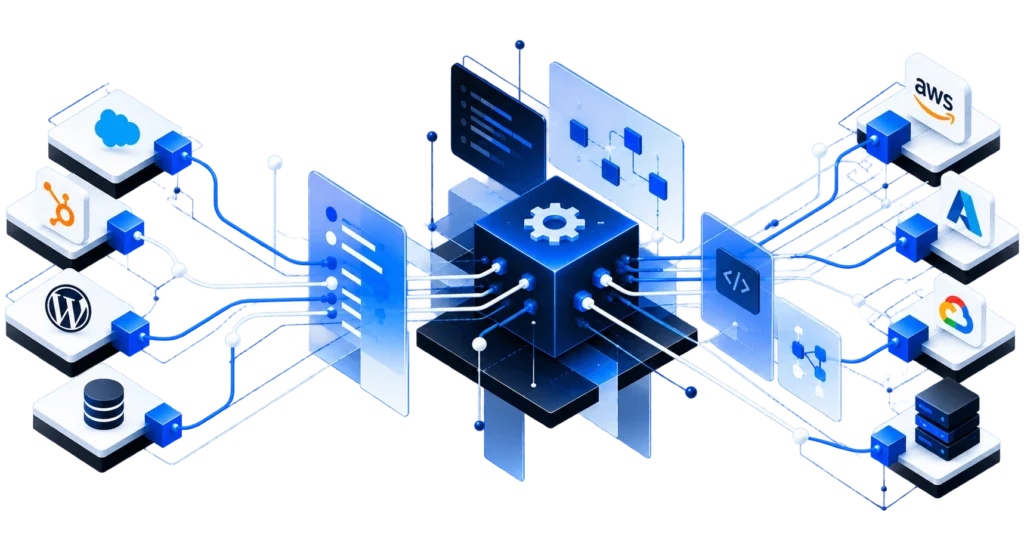
We build custom API and software integrations that allow applications, platforms, databases, and third-party services to exchange information and work together.
Whether you need to connect an existing application to a new platform, automate data moving between systems, integrate a third-party service, or build the API layer behind a larger application, we design the integration around the actual business process and the systems involved.
When Systems Stop Working Together
Your Software Shouldn't Require People to Move Data Between It
Most organizations use more than one software system.
Customer information may live in a CRM. Orders may live somewhere else. Payments run through another platform. Employees use an internal application. Reports depend on data from several sources. A vendor or partner has its own system that your team cannot control.
The problem begins when those systems need the same information but cannot exchange it reliably.
An integration project may make sense when:
-
Employees repeatedly copy information from one system into another.
-
The same customer, order, account, or transaction data is maintained in multiple places.
-
Customers or employees have to switch between several systems to complete one workflow.
-
A new platform needs to work with an older custom application.
-
An existing integration is unreliable, undocumented, or difficult to maintain.
-
Your application needs functionality or data provided by a third-party service.
-
A portal, dashboard, SaaS product, or internal application needs to communicate with external systems.
Make Separate Systems Behave Like Part of the Same Process
An integration is useful when it removes a boundary that should not exist for the people using the software.
A customer should not care that their account information comes from one system while their invoices come from another. An operations team should not need to know which API provides a status update before acting on it. An employee should not have to copy data manually because two applications were purchased at different times.
Custom integration creates the software layer that coordinates those systems.
That may be a relatively simple API connection. It may also require authentication, data transformation, synchronization, background processing, error handling, webhooks, business rules, administrative controls, and monitoring.
A successful integration is measured by whether the business process works reliably across the systems behind it, not by whether two endpoints exchanged data once.
Integration Development
Connect Applications, Platforms, Data, and Business Workflows
Third-Party API Integrations
Connect applications with external services for payments, communications, identity, mapping, marketing, analytics, logistics, documents, or other specialized functionality.
Application-to-Application Integration
Allow separate business applications to exchange records, trigger workflows, synchronize information, and coordinate activity.
CRM and ERP Integrations
Connect customer, account, product, inventory, order, invoice, fulfillment, and other operational information with the applications and workflows that need it.
Payment and Billing Integrations
Integrate payment processing, subscriptions, invoices, transactions, refunds, balances, and other financial workflows into custom applications.
Database and Data Integrations
Move, synchronize, transform, or expose information stored across databases and applications when API access is unavailable or insufficient.
Legacy System Integrations
Connect newer applications and services with older software so valuable existing systems can continue operating while the surrounding technology changes.
Custom API Development
Build APIs that allow your own applications, services, partners, or future integrations to access business functionality through a defined interface.
Keeping Systems in Agreement
When Two Systems Need to Agree About the Same Data
Some integrations perform a single transaction. Others need information to remain synchronized over time.
A customer updated in one system may need to change in another. An order may need to appear in an operational platform. Inventory may need periodic updates. Account status may determine what a user can access somewhere else.
Those workflows require decisions about which system owns each piece of information, which direction data should move, how quickly updates need to happen, and what should occur when the systems disagree.
Data Ownership
Define which system is authoritative for important records instead of allowing several applications to independently overwrite the same information.
Synchronization and Transformation
Move information in one or both directions and translate records when different systems represent customers, products, statuses, identifiers, dates, or other data differently.
Timing and Processing
Use APIs, webhooks, events, scheduled synchronization, or background processing according to how quickly information actually needs to move.
Conflict Handling
Establish what should happen when records disagree, updates arrive out of order, or several systems attempt to change the same information.
Built for Production
Integrations Need a Plan for When Things Go Wrong
External systems fail. Requests time out. APIs return errors. Credentials expire. Rate limits are reached. Webhooks arrive twice. Networks become unavailable. Vendors change their APIs. A downstream system may accept a request even though the response never reaches your application.
A production integration needs to account for those conditions instead of assuming every request succeeds the first time.
Error Handling and Recovery
Handle expected failures deliberately and establish what users or administrators should be able to do when a dependency becomes unavailable.
Retries and Background Processing
Move appropriate work into background processes and retry temporary failures when repeating the operation is safe.
Duplicate Protection
Protect critical operations from creating duplicate payments, orders, records, notifications, or other unintended actions when requests or events are repeated.
Logging and Monitoring
Capture enough information to identify failed integrations, understand where they failed, and determine what needs attention.
Rate Limits and External Constraints
Design processing around the actual capacity, availability, and limitations of the external systems involved.
Integration Security
Protect the Data Moving Between Systems
Integrations often have access to information and actions that ordinary application users do not.
API credentials may permit access to customer records, financial information, orders, internal systems, or administrative functionality. Integration security therefore needs to be part of the architecture rather than added after the connection is working.
Depending on the systems involved, that can include secure credential storage, encrypted transport, OAuth or token-based authorization, permission scoping, request validation, webhook verification, access controls, and audit logging.
Each integration should receive the access required for its workflow without unnecessarily expanding the security boundary around the application.
Custom API Development
When Your Own Software Needs an Integration Layer
Sometimes the system that needs an API is yours.
An existing application may need to expose functionality to a new frontend, mobile application, customer portal, partner, internal service, or third-party platform.
We design and build APIs that create a defined interface around application data and business functionality.
Depending on the project, that may include REST API development, authentication and authorization, validation, endpoint design, filtering and pagination, rate limiting, webhooks, background processing, documentation, automated testing, and production monitoring.
The API should create a maintainable contract between systems rather than exposing internal application behavior indiscriminately.
Connect What You Already Have
Existing Software Does Not Automatically Need to Be Replaced
A business does not need to rebuild an application simply because it was created before the systems it now needs to connect with.
Existing PHP and Laravel applications, custom business software, databases, portals, administrative systems, and other web applications can often be extended with an integration layer that allows them to participate in newer workflows.
That may mean adding API endpoints, building a separate service around the application, or making targeted changes to the existing system. If the integration exposes larger technical limitations, broader modernization may be worth considering.
Remove the Manual Handoff
Integration Can Automate Work Between Applications
Some of the most valuable integration work is almost invisible to the end user.
An order entered in one system creates a record in another. A payment changes account access. A completed form updates the CRM. A new customer triggers onboarding. A status change sends a notification. A scheduled process synchronizes records that employees previously moved by hand.
These workflows can reduce repetitive data entry and make business processes more consistent.
When automation fails, however, the system should make the problem visible and provide a path to recovery rather than silently losing the work.
INTEGRATIONS INSIDE LARGER APPLICATIONS
Integration Is Often Part of a Larger Software Project
API integration does not always begin as a standalone project.
A customer portal may need account and billing data from several platforms. A dashboard may need information from an ERP and CRM. A SaaS application may depend on payment, messaging, or identity providers. A legacy application may need to communicate with newer systems.
When integration is part of a larger application, we design it around the complete workflow rather than treating the connection as an isolated technical task.
How We Approach Integration Projects
Understand the Workflow Before Connecting the APIs
Map the Workflow and Systems
Define what needs to happen, which users and systems are involved, where the current process breaks down, and which applications, databases, APIs, and services contain the required information or functionality.
Define Data and Integration Behavior
Establish data ownership, how information should move, available APIs and webhooks, authentication requirements, data formats, external limitations, and what should happen when systems disagree or become unavailable.
Build and Test
Implement the integration and test successful workflows alongside failures, retries, duplicate events, permissions, edge cases, and data consistency.
Deploy and Monitor
Move the integration into production with appropriate configuration, logging, monitoring, and operational visibility, then maintain the connection as external APIs and business requirements change.
Existing Integrations
Fix or Extend an Integration Someone Else Built
Not every integration project starts from scratch.
We can work with existing integration code when a connection has become unreliable, a third-party API has changed, documentation is incomplete, new functionality is required, or the original developer is no longer available.
The first step is understanding how the current integration works, what systems depend on it, and where the failure or limitation actually occurs.
From there, the work may involve debugging, replacing obsolete API calls, updating authentication, improving failure handling, adding monitoring, restructuring synchronization, extending functionality, or rebuilding only the parts that no longer make sense.
API Integration Services FAQs
What is API integration?
API integration connects applications or services so they can exchange information or trigger functionality programmatically.
It allows one system to use data or capabilities provided by another without requiring users to manually move information between them.
What systems can you integrate?
Integration is possible when the systems provide an appropriate technical path for exchanging information. That may include REST APIs, webhooks, databases, file exchange, SDKs, or other supported interfaces.
We evaluate the specific systems involved before recommending an integration approach.
Can you connect an older application to a modern API?
Often, yes. Older custom applications can frequently be extended with an integration layer without replacing the entire system.
The appropriate approach depends on the application’s architecture, runtime, security, existing code, and ability to support the required changes.
Do you build custom REST APIs?
Yes. We design and build REST APIs for custom web applications, portals, dashboards, integrations, internal services, and other software that needs a defined interface for accessing business functionality or data.
Can you fix an existing broken integration?
Yes. Existing integrations can be reviewed and repaired when APIs change, credentials fail, synchronization becomes unreliable, failure handling is insufficient, or the original implementation has become difficult to maintain.
How much does API integration development cost?
Cost depends on the number of systems involved, API quality, authentication requirements, data complexity, synchronization rules, business logic, failure handling, testing requirements, and the condition of any existing application being integrated.
Most of our development engagements start at $5,000. A focused third-party integration may remain relatively contained, while multi-system integrations or integrations embedded in larger business applications can require substantially more work.
Connect Your Systems
Stop Making People Work Around Disconnected Software
Tell us which systems need to communicate, what information needs to move between them, and how your team handles the process today.
We can help determine the right integration approach and what needs to happen to make the workflow reliable in production.